Drone or helicopter?
Two complementary approaches to aerial cinematography — rushes available for licensing
The drone revolution has profoundly transformed aerial cinematography over the past ten years. But contrary to what is often said, the drone has not replaced the helicopter — it has opened up a new territory of possibilities, complementary and sometimes irreplaceable. At Aerialcollection, we distribute footage shot with both systems, and we are able to organise shoots with either one depending on your production's needs. The certification of our remote pilote includes STS01-02 in Europe, A1 A2 A3 in the United Kingdom and Part 107 day-night in the United States.
The advantages of drones — The drone is lightweight, discreet, transportable in the hold of a commercial aircraft, operable by a two-person crew and at a logistical cost that bears no comparison with a helicopter. It can fly in areas inaccessible to crewed aircraft, land on improbable terrain, and approach wildlife and communities at distances impossible from a helicopter without disturbing them. Today it is capable of capturing footage in 4K and 8K at cinema quality — a revolution that has happened in less than a decade.
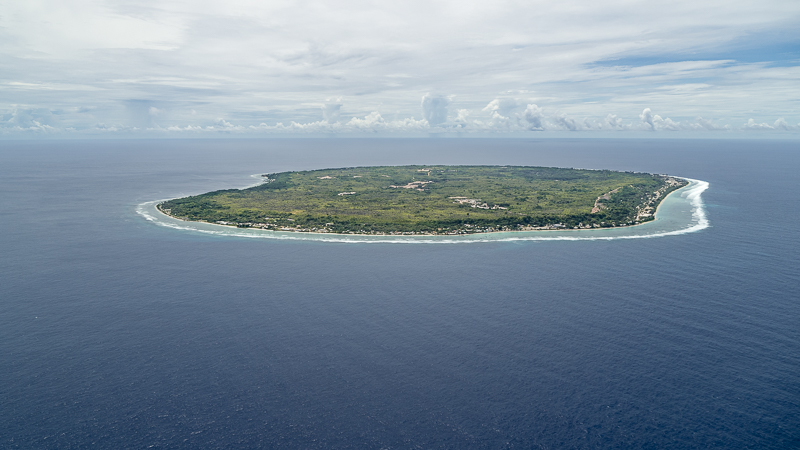
It is the natural choice for shoots in remote areas where fuel resupply is impossible, for scientific or humanitarian expeditions where weight and volume are constrained, and for productions concerned about their carbon footprint. Our collections from the Iberá reserve in Argentina (DJI Inspire 2 drone embedded with the Rewilding Argentina teams), from Antarctica (ground-level drone in extreme temperature conditions) and from Nauru (isolated island with no aeronautical infrastructure) illustrate situations where the drone was the only viable solution.
The limitations of drones — The drone remains constrained by its autonomy (20 to 30 minutes per battery), its sensitivity to wind and weather conditions, and above all by aviation regulations — increasingly strict in most countries, with exclusion zones that can cover most of a territory. Its limited speed and range mean it cannot cover large distances in a single day.
The advantages of the gyro-stabilised helicopter — The helicopter equipped with a Cineflex or GSS gyro-stabilised system remains irreplaceable for large-scale shoots. In a single day of flying, it can cover several hundred kilometres and film dozens of different sites — a geographical coverage capability that the drone simply cannot match. Its wide-range optics allow filming from very long distances with exceptional quality, avoiding any impact on the wildlife or populations being filmed. The gyroscopic stabilisation guarantees a fluidity of movement impossible to achieve with a drone, even a stabilised one.
Our shoots in Ethiopia — where we covered the Danakil, Lalibela, Tigray, Lake Tana and the Simien Mountains in just a few days — or in Pakistan — where the helicopter allowed us to move in a single day from the plains of Punjab to the Karakoram valleys at 5,000 metres altitude — illustrate what only a helicopter makes possible. Similarly, complex local configurations such as the Philippines after Typhoon Haiyan, where airspace was controlled and drones prohibited, or the Dominican Republic, could not have been covered any other way.
The limitations of the helicopter — Cost, logistics and carbon footprint are the main constraints. A helicopter shoot requires overflight authorisations, a qualified pilot, a gyro-stabilised camera operator, regular fuel resupply and local aeronautical infrastructure. In some parts of the world, these conditions are difficult or impossible to meet — as in Venezuela, where flights have become extremely hazardous, or in conflict zones.
Our recommendation — The choice between drone and helicopter depends above all on the project, the territory and the budget. For a documentary on a single accessible site, the 4K/8K drone today offers an unbeatable quality-to-cost ratio. For a production requiring wide geographical coverage, uncompromising cinema quality or overflights of regulated zones, the gyro-stabilised helicopter remains the reference. Contact us to describe your project — we will advise you on the most suitable solution and can organise both types of shoot with our partner Papa Sierra
Isolated from everything, far from conventional aerial means, the Republic of Nauru is an ideal location for drone filming (with the required authorisations).