
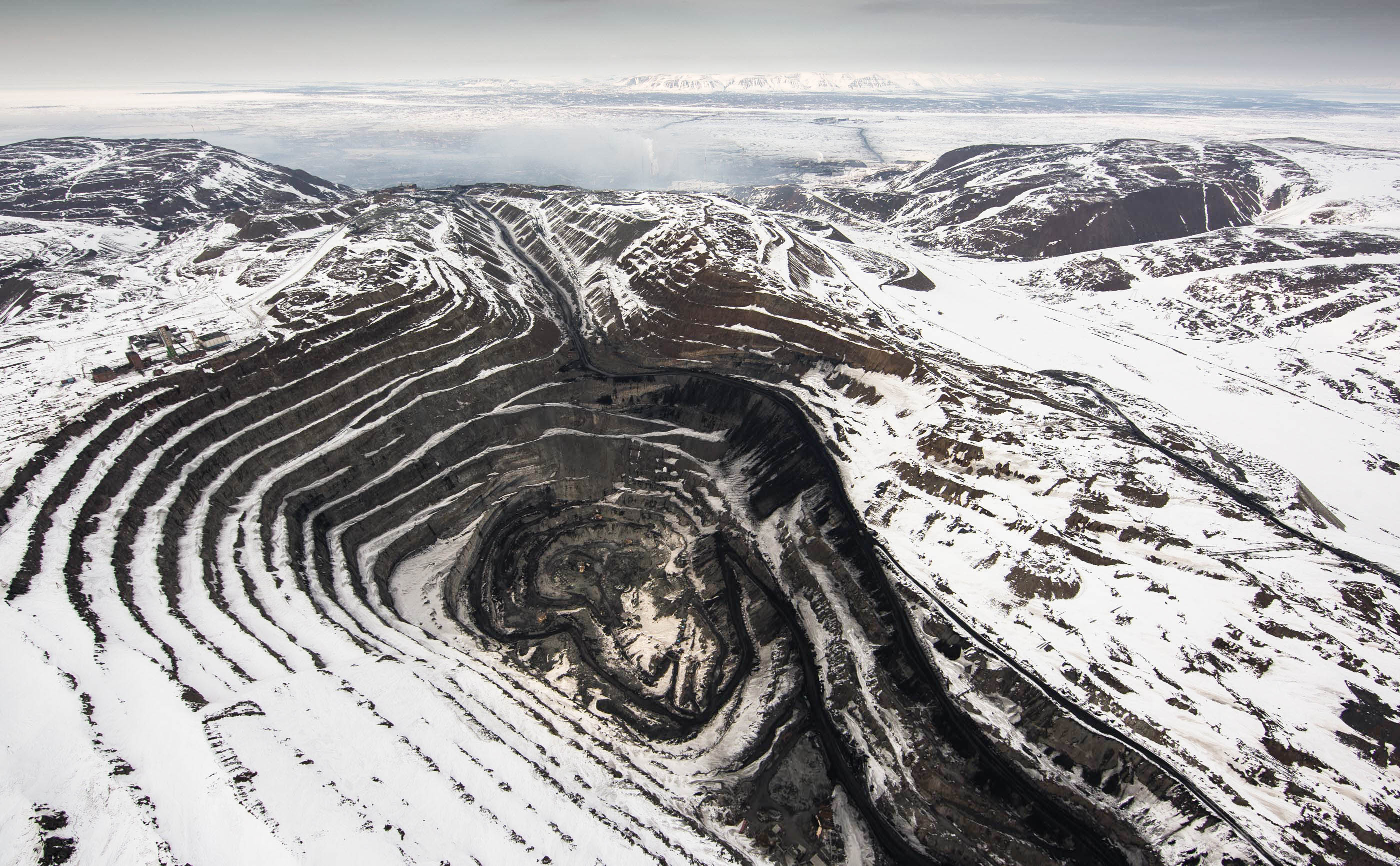
The rushes we distribute include aerial footage of an icebreaker on the Yenisei River near Dudinka, and of the city and industries of Norilsk.
Norilsk — Pollution and dependency in the heart of Siberia
Norilsk is a city that should never have existed. Built by forced Gulag labour from the 1930s onwards, buried in the Siberian tundra more than 300 kilometres north of the Arctic Circle, it is home today to nearly 180,000 inhabitants in one of the coldest and most polluted cities on the planet. Temperatures can drop below -50°C in winter, and the polar night lasts several weeks.
And yet Norilsk is indispensable to the modern world. Its mines and smelters produce approximately 10% of the world's nickel and copper, and nearly 40% of its palladium — a precious metal used in catalytic converters and in the electronics industry. What our smartphones and our "clean" cars conceal, Norilsk displays without pretence : the fumes from the ore-processing plants, barely filtered, drift directly over the city centre, blackening the snow and the lungs of its inhabitants. The city is regularly ranked among the most contaminated sites on the planet.
A city closed to the world — Norilsk is a closed city — to foreigners, but also to Russians who have no official reason to be there. About ten years ago, when we were considering making a documentary film about Russia, we deliberately chose Norilsk as a first test of our local partners' goodwill — the most difficult place to access in the country. Against all expectations, we were warmly welcomed. The film project was ultimately abandoned, but the footage shot on that occasion now constitutes one of the rarest aerial documents in our collection.
The icebreaker on the Yenisei — A few dozen kilometres north of Norilsk, the port town of Dudinka is the only maritime access point to this landlocked region. In spring, icebreakers make their way up the Yenisei River to open the passage for river navigation — a spectacle of rare visual power, captured from our helicopter in raking Arctic light.
The Nenets nomads — Away from the industrial complex, the Siberian tundra is still traversed by the Nenets, a nomadic people who have herded reindeer for millennia, moving with their herds between seasonal grazing grounds in extreme climatic conditions. Our aerial images of their encampments amid the vast white expanse of the tundra form a striking counterpoint to the smelter fumes of Norilsk.
While our images document the industrial extremes and environmental damage of the site, the work of French-Russian photographer Elena Chernyshova beautifully captures the paradoxes of this unique place — the strange beauty of a city condemned to survive the impossible.
This footage was shot using a gyro-stabilised Cineflex HD camera, mounted aboard a French-built Airbus H350 helicopter.
Aerial footage of Siberia
About ten years ago we considered shooting a film about Russia, a project that was quickly abandoned despite all the local help we could get and despite the strong desire we had to do it.
At the beginning of the project, to test the goodwill of our partners, we asked for the place that was probably the most difficult to access: Norilsk, a city closed to Russians themselves, closed to foreigners... One of the most polluted cities in the world, a former gulag, in the far north of Siberia. Also one of the coldest in the world with temperatures that can drop below -50 degrees and weeks of polar night.
We were warmly welcomed there. Shooting done with a Cineflex gyro-stabilized HD camera installed on a French-made H350 helicopter.
At the beginning of the project, to test the goodwill of our partners, we asked for the place that was probably the most difficult to access: Norilsk, a city closed to Russians themselves, closed to foreigners... One of the most polluted cities in the world, a former gulag, in the far north of Siberia. Also one of the coldest in the world with temperatures that can drop below -50 degrees and weeks of polar night.
We were warmly welcomed there. Shooting done with a Cineflex gyro-stabilized HD camera installed on a French-made H350 helicopter.