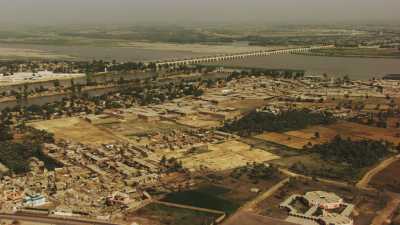
Sukkur Barrage is a barrage on the River Indus near the city of Sukkur in the Sindh province of Pakistan. The Barrage was built during the British Raj from 1923 to 1932 and was named Lloyd Barrage. The Sukkur Barrage, is the pride of Pakistan’s Irrigation system as it is the largest single Irrigation network of its kind in the world. It irrigates from Sukkur District in the North, to Mirpurkhas/ Tharparkar and Hyderabad districts in the South of Sindh, almost all parts of the Province except few. It is situated about 300 miles North East of Karachi, 3 miles below the Railway Bridge, or the Sukkur Gorge. The introduction of barrage-controlled irrigation system resulted in more timely water supplies for the existing cultivated areas of Sindh Province of Pakistan.
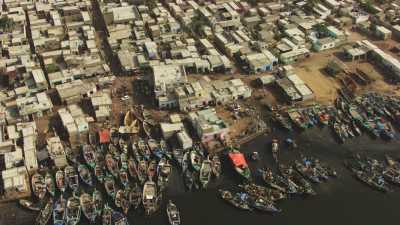
Rehri or Rehri Goth, a 300-year-old site, is one of the neighbourhoods of Bin Qasim Town in Karachi, Sindh, Pakistan. Rehri is located on the Arabian Sea coast and has large a community of fishermen.
There are several ethnic groups in Bin Qasim Town including Urdu speakers, Punjabis, Sindhis, Kashmiris, Seraikis, Pakhtuns, Balochs, Memons, Bohras, Ismailis. Over 99% of the population is Muslim. The population of Bin Qasim Town is estimated to be nearly one million.
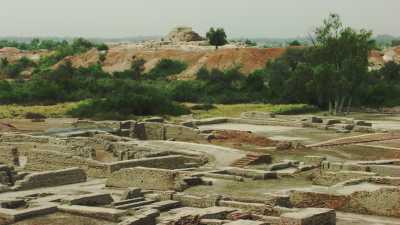
Mohenjo-daro is an archaeological site in the province of Sindh, Pakistan. Built around 2500 BCE, it was one of the largest settlements of the ancient Indus Valley civilization, and one of the world's earliest major cities, contemporaneous with the civilizations of ancient Egypt, Mesopotamia, Minoan Crete, and Norte Chico. Mohenjo-daro was abandoned in the 19th century BCE as the Indus Valley Civilization declined, and the site was not rediscovered until the 1920s. Significant excavation has since been conducted at the site of the city, which was designated an UNESCO World Heritage Site in 1980. The site is currently threatened by erosion and improper restoration.
Karachi is the capital of the Pakistani province of Sindh. It is the most populous city in Pakistan, sixth most populous city proper in the world and the 8th most populous metropolitan city in the world. Ranked as a beta world city, the city is Pakistan's premier industrial and financial centre. Karachi is also Pakistan's most cosmopolitan city. Situated on the Arabian Sea, Karachi serves as a transport hub, and is home to two of Pakistan's two largest seaports, the Port of Karachi and Port Bin Qasim, as well as the busiest airport in Pakistan.
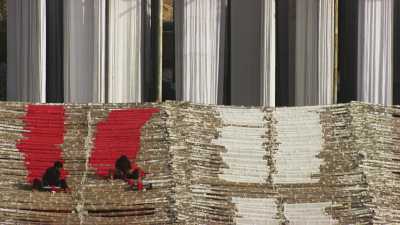
Young workers spread out dyed fabrics if order to dry them. India’s natural dyes, especially those for blue and red, have been renowned for millennia. Blue dye was so closely associated with India that the ancient Greeks took its western name – indikos (indigo) – from the country itself. Red dyeing with fixing agents (mordants) was known to the Indus valley civilisation by about 2500 BC. Fixing the colour is the great challenge of dyeing cloth. Indian dyers’ use of mordants was key to their expertise, which was unrivalled until the invention of western chemical dyes in the 19th century. It is this wealth and mastery of bright and lasting natural dyes that perhaps best distinguishes India’s textile heritage.