Geneva is a Swiss city located at the western end of Lake Geneva. In terms of population, it is Switzerland's second-largest city after Zurich. It is the capital and most populated municipality of the Canton of Geneva. In December 2015, the city had 201,164 inhabitants. Its metropolitan area forms a cross-border agglomeration: "Greater Geneva," which extends across the Vaud canton and the French departments of Ain and Haute-Savoie, with a total population ranging from 605,000 to 946,000 inhabitants depending on criteria used. The city's iconic landmark is its water jet reaching 140 meters in height.
Geneva is a Swiss city located at the western end of Lake Geneva. In terms of population, it is the second most populated city in Switzerland after Zurich. It is the capital and most populous municipality of the canton of Geneva. In December 2015, the city had 201,164 inhabitants. Its metropolitan area forms a cross-border agglomeration: the "Greater Geneva", which extends across the canton of Vaud and the French departments of Ain and Haute-Savoie, with a total population ranging from 605,000 to 946,000 inhabitants depending on the criteria used. The city's emblem is its water jet fountain reaching 140 meters high.
Lake Geneva (French: le lac Léman or le Léman) is a lake on the north side of the Alps, shared between Switzerland and France. It is one of the largest lakes in Western Europe and the largest on the course of the Rhône.
Lake Geneva is the largest body of water in Switzerland, and greatly exceeds in size all others that are connected with the main valleys of the Alps. It is in the shape of a crescent, with the horns pointing south. The beauty of the shores of the lake and of the sites of many of the places near its banks has long been celebrated. However, it is only from the eastern end of the lake, between Vevey and Villeneuve, that the scenery assumes an Alpine character. On the south side the mountains of Savoy and Valais are for the most part rugged and sombre, while those of the northern shore fall in gentle vine-covered slopes, thickly set with villages and castles.
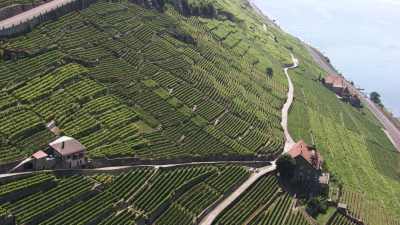
The Lavaux Vineyard Terraces, stretching for about 30 km along the south-facing northern shores of Lake Geneva from the Chateau de Chillon to the eastern outskirts of Lausanne in the Vaud region, cover the lower slopes of the mountainside between the villages and the lake. Although there is some evidence that vines were grown in the area in Roman times, the present vine terraces can be traced back to the 11th century, when Benedictine and Cistercian monasteries controlled the area. It is an outstanding example of a centuries-long interaction between people and their environment, developed to optimize local resources so as to produce a highly valued wine that has always been important to the economy.
Lake Geneva (French: le lac Léman or le Léman) is a lake on the north side of the Alps, shared between Switzerland and France. It is one of the largest lakes in Western Europe and the largest on the course of the Rhône.
Lake Geneva is the largest body of water in Switzerland, and greatly exceeds in size all others that are connected with the main valleys of the Alps. It is in the shape of a crescent, with the horns pointing south. The beauty of the shores of the lake and of the sites of many of the places near its banks has long been celebrated. However, it is only from the eastern end of the lake, between Vevey and Villeneuve, that the scenery assumes an Alpine character. On the south side the mountains of Savoy and Valais are for the most part rugged and sombre, while those of the northern shore fall in gentle vine-covered slopes, thickly set with villages and castles.
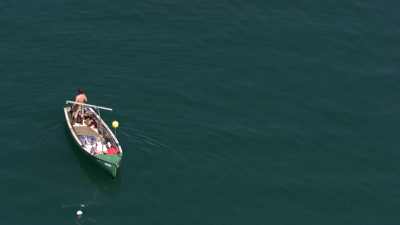
Around 150 fishermen practice professional fishing on Geneva Lake, 50 on the French side. Highly controled, it is opened from mid-january to end of october.
It is a hard and physical profession, lifting nests under all weather conditions on a fragile boat.
Coregone fish catch varies from 30 kgs to 150 kgs per catch.
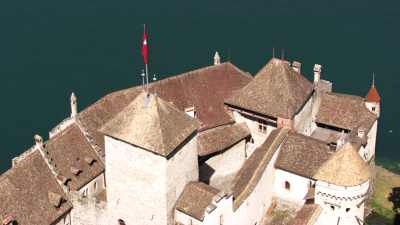
Chillon Castle is an island castle located on Lake Geneva south of Veytaux in the canton of Vaud. It is situated at the eastern end of the lake, on the narrow shore between Montreux and Villeneuve, which gives access to the Alpine valley of the Rhone. Chillon, a XIIth century castle, is amongst the most visited castles in Switzerland and Europe.
Geneva is a Swiss city located at the western end of Lake Geneva. In terms of population, it is the second most populous city in Switzerland after Zurich. It is the capital and most populous municipality of the Canton of Geneva. In December 2015, the city had 201,164 inhabitants. Its metropolitan area, or urban area, forms a cross-border agglomeration: the "Greater Geneva", which extends across the Canton of Vaud and the French departments of Ain and Haute-Savoie, with a total population, depending on the criteria used, ranging from 605,000 to 946,000 inhabitants. The city's emblem is its water jet fountain reaching 140 meters in height.
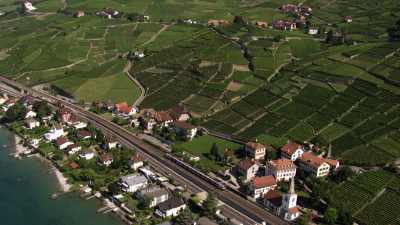
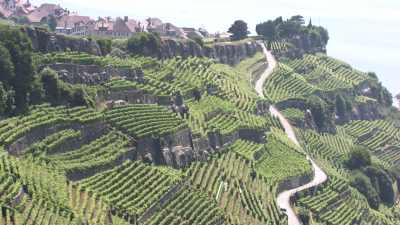
Close shots of the vineyards and villages on the lake shores. The Lavaux Vineyard Terraces, stretching for about 30 km along the south-facing northern shores of Lake Geneva from the Chateau de Chillon to the eastern outskirts of Lausanne in the Vaud region, cover the lower slopes of the mountainside between the villages and the lake. Although there is some evidence that vines were grown in the area in Roman times, the present vine terraces can be traced back to the 11th century, when Benedictine and Cistercian monasteries controlled the area. It is an outstanding example of a centuries-long interaction between people and their environment, developed to optimize local resources so as to produce a highly valued wine that has always been important to the economy.
Close shots of the vineyards and villages on the lake shores. The Lavaux Vineyard Terraces, stretching for about 30 km along the south-facing northern shores of Lake Geneva from the Chateau de Chillon to the eastern outskirts of Lausanne in the Vaud region, cover the lower slopes of the mountainside between the villages and the lake. Although there is some evidence that vines were grown in the area in Roman times, the present vine terraces can be traced back to the 11th century, when Benedictine and Cistercian monasteries controlled the area. It is an outstanding example of a centuries-long interaction between people and their environment, developed to optimize local resources so as to produce a highly valued wine that has always been important to the economy.