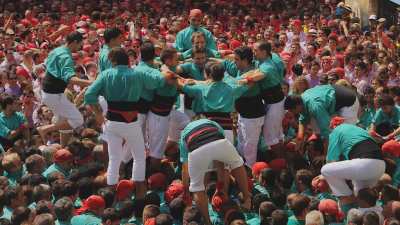
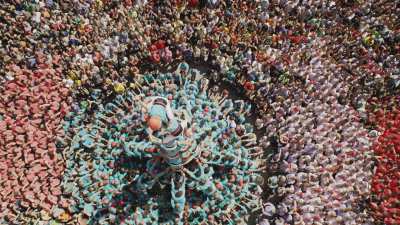
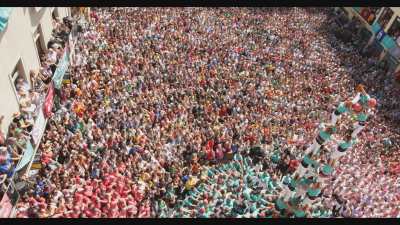
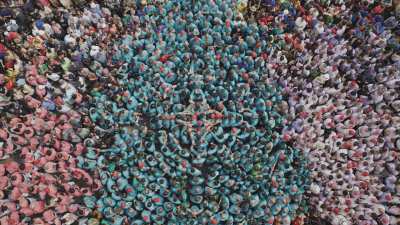
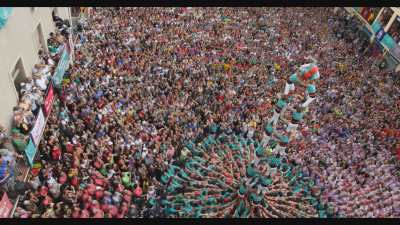
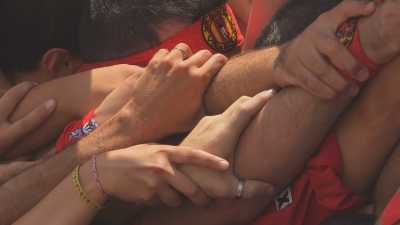
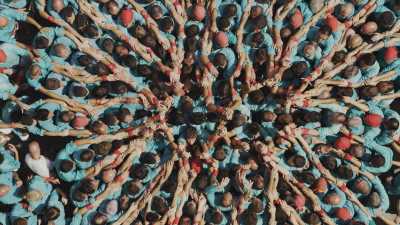
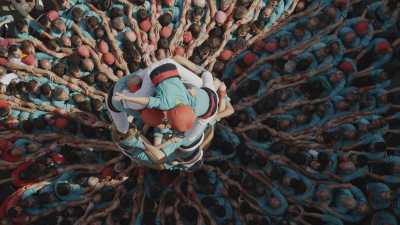
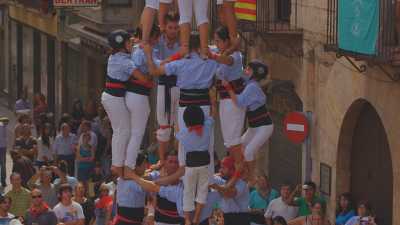
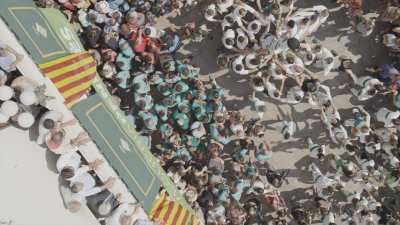
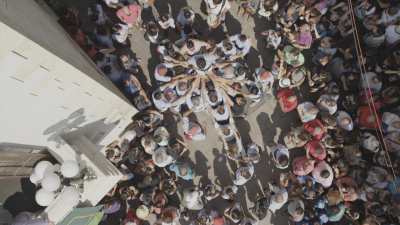
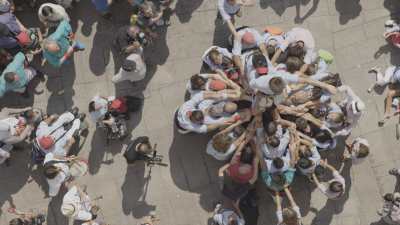
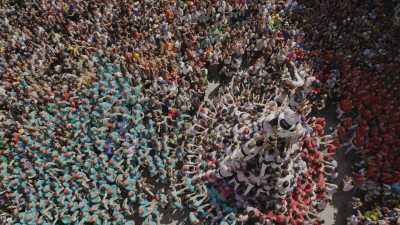
Very close shots of castellers. A castell is a human tower built traditionally in festivals at many locations within Catalonia. At these festivals, several colles castelleres (groups who construct towers) often succeed in building and dismantling a tower's structure. On November 16, 2010, castells were declared by UNESCO to be amongst the Masterpieces of the Oral and Intangible Heritage of Humanity.
Very close shots of castellers. A castell is a human tower built traditionally in festivals at many locations within Catalonia. At these festivals, several colles castelleres (groups who construct towers) often succeed in building and dismantling a tower's structure. On November 16, 2010, castells were declared by UNESCO to be amongst the Masterpieces of the Oral and Intangible Heritage of Humanity.
Close shots of Castellers. A castell is a human tower built traditionally in festivals at many locations within Catalonia. At these festivals, several colles castelleres (groups who construct towers) often succeed in building and dismantling a tower's structure. On November 16, 2010, castells were declared by UNESCO to be amongst the Masterpieces of the Oral and Intangible Heritage of Humanity.
A castell is a human tower built traditionally in festivals at many locations within Catalonia. At these festivals, several colles castelleres (groups who construct towers) often succeed in building and dismantling a tower's structure. On November 16, 2010, castells were declared by UNESCO to be amongst the Masterpieces of the Oral and Intangible Heritage of Humanity.
A castell is a human tower built traditionally in festivals at many locations within Catalonia. At these festivals, several colles castelleres (groups who construct towers) often succeed in building and dismantling a tower's structure. On November 16, 2010, castells were declared by UNESCO to be amongst the Masterpieces of the Oral and Intangible Heritage of Humanity.
A castell is a human tower built traditionally in festivals at many locations within Catalonia. At these festivals, several colles castelleres (groups who construct towers) often succeed in building and dismantling a tower's structure. On November 16, 2010, castells were declared by UNESCO to be amongst the Masterpieces of the Oral and Intangible Heritage of Humanity.
A castell is a human tower built traditionally in festivals at many locations within Catalonia. At these festivals, several colles castelleres (groups who construct towers) often succeed in building and dismantling a tower's structure. On November 16, 2010, castells were declared by UNESCO to be amongst the Masterpieces of the Oral and Intangible Heritage of Humanity.
A castell is a human tower built traditionally in festivals at many locations within Catalonia. At these festivals, several colles castelleres (groups who construct towers) often succeed in building and dismantling a tower's structure. On November 16, 2010, castells were declared by UNESCO to be amongst the Masterpieces of the Oral and Intangible Heritage of Humanity.
A castell is a human tower built traditionally in festivals at many locations within Catalonia. At these festivals, several colles castelleres (groups who construct towers) often succeed in building and dismantling a tower's structure. On November 16, 2010, castells were declared by UNESCO to be amongst the Masterpieces of the Oral and Intangible Heritage of Humanity.
A castell is a human tower built traditionally in festivals at many locations within Catalonia. At these festivals, several colles castelleres (groups who construct towers) often succeed in building and dismantling a tower's structure. On November 16, 2010, castells were declared by UNESCO to be amongst the Masterpieces of the Oral and Intangible Heritage of Humanity.
A castell is a human tower built traditionally in festivals at many locations within Catalonia. At these festivals, several colles castelleres (groups who construct towers) often succeed in building and dismantling a tower's structure. On November 16, 2010, castells were declared by UNESCO to be amongst the Masterpieces of the Oral and Intangible Heritage of Humanity.
A castell is a human tower built traditionally in festivals at many locations within Catalonia. At these festivals, several colles castelleres (groups who construct towers) often succeed in building and dismantling a tower's structure. On November 16, 2010, castells were declared by UNESCO to be amongst the Masterpieces of the Oral and Intangible Heritage of Humanity.
A castell is a human tower built traditionally in festivals at many locations within Catalonia. At these festivals, several colles castelleres (groups who construct towers) often succeed in building and dismantling a tower's structure. On November 16, 2010, castells were declared by UNESCO to be amongst the Masterpieces of the Oral and Intangible Heritage of Humanity.
A castell is a human tower built traditionally in festivals at many locations within Catalonia. At these festivals, several colles castelleres (groups who construct towers) often succeed in building and dismantling a tower's structure. On November 16, 2010, castells were declared by UNESCO to be amongst the Masterpieces of the Oral and Intangible Heritage of Humanity.
A castell ("castle" in Catalan) is a traditional cultural manifestation of Catalan-speaking countries consisting of building a human pyramid of six to ten stories with well-defined form and organization. Unlike other Catalan human towers, it is, in principle, static.
A colla castellera is a group of people creating human pyramids. Each team is recognizable by the color of their shirt.
The castells of Catalonia are inscribed by Spain on the Representative List of the Intangible Cultural Heritage of Humanity.